
Global Mobility Adviser Launches “Relocation Fundamentals”
A Practical Course for HR, Real Estate, and Mobility Professionals Global Mobility Adviser has announced the launch of its new course, Relocation Fundamentals, designed to provide a clear and practical introduction to the world of corporate relocation. Aimed at HR professionals, real estate partners, and those entering the mobility field, the course delivers four hours of engaging, accessible content that demystifies how relocation programs are designed, administered, and supported.
Global Mobility Adviser Launches CRP Exam Preparation Course

Self-Paced Training Curated by Industry Veteran for WERC Certified Relocation Professional Certification Global Mobility Adviser has launched its CRP Exam Preparation Course, a practical, self-paced online program designed for professionals preparing for the WERC Certified Relocation Professional (CRP) exam. Curated by Steven John, CPA, SCRP, SGMS-T — 20-year relocation veteran and past chairman of the WERC CRP Certification Review Board — the course delivers focused subject-matter training aligned with the latest WERC exam materials plus more than 500 mock exam questions. It cuts through the volume of source content to focus on what actually gets tested and applied on the job.
Global Mobility Adviser Welcomes Steven John, CPA, SCRP, SGMS-T
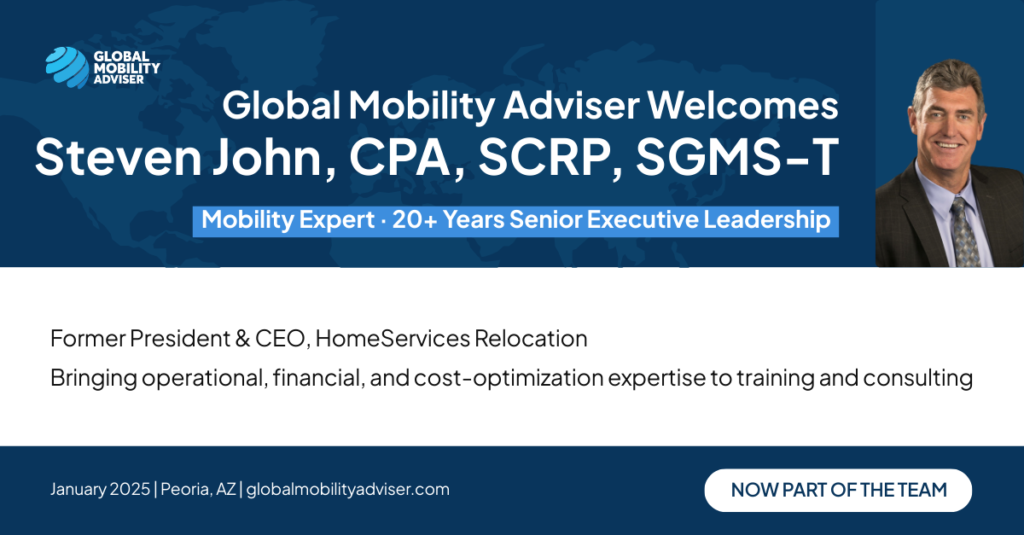
Strengthening Practical Training and Consulting with 20-Year Industry Expertise Global Mobility Adviser has announced that Steven John, CPA, SCRP, SGMS-T, has joined the team as Senior Consultant and Course Curator. A 20-year veteran of corporate relocation and past chairman of the WERC CRP Certification Review Board, Steven brings deep operational and financial experience to GMA’s education and client work. His role focuses on building clear, exam-ready training and translating complex mobility systems into actionable guidance for HR, real estate, and mobility professionals.
THE FUTURE OF EXPAT PAY: MOVING PAST EQUALIZATION TOWARD FLEXIBILITY AND FAIRNESS
As the global workforce evolves, organizational strategies for managing expatriate compensation must also evolve. Consider the scenario of hiring for an essential role in Singapore and finding the perfect candidate who is eager for the international opportunity. Everyone is excited until compensation becomes a barrier. The candidate declines, citing financial infeasibility, or senior leadership balks at the high cost. This real-life scenario underscores the critical need for effective expatriate compensation strategies. For global talent leaders, these scenarios are not mere imagination, but a reality they face all too frequently. The challenges of compensating international assignments and transfers are a cornerstone issue in assuring a globally mobile workforce. Today, following trends primarily from Europe, multinationals, including those headquartered in the U.S., are increasingly using alternate compensation strategies for their globally mobile talent to overcome these types of issues. This article aims to delve into why they are doing so, what those approaches are, and the important considerations for using these alternates, all of which are crucial for your role as a global talent leader The Balance Sheet Approach, Why It Worked (and Why It’s Fading) For more than half a century, the balance sheet was the gold standard for expat pay. It was elegant in concept: keep employees financially “whole” when they move abroad, no better off and no worse off than if they’d stayed home. On paper, it made perfect sense. Developed in the postwar era by compensation pioneers like AIRINC and ORC (now Mercer), the balance sheet relied on meticulous financial modeling to compare home and host locations. Housing, goods and services, transportation, taxes, everything was accounted for. The goal was fairness and predictability. And for a long time, it worked. It helped build trust between employees and employers at a time when global assignments felt like uncharted territory. The balance sheet reassured families that a move overseas wouldn’t mean an uncertain financial future. But here’s the problem: what worked in 1970 doesn’t always work in 2025. The balance sheet has become one of the most complex, expensive, and administratively heavy processes in global mobility. It requires endless data subscriptions, tax assistance, split payrolls, and constant currency updates. Even when it’s done perfectly, it’s rarely perceived as fair, which defeats the entire purpose I remember visiting a company years ago where a group of Australian engineers were convinced their allowances were far too low. We reviewed their reports, line by line, only to discover they’d been paid double by mistake. And still, they weren’t happy. It’s a perfect example of how even the most precise models can’t always align with human perception. At its best, the balance sheet is structured, logical, and protective. At its worst, it’s a bureaucratic migraine that sometimes creates as many inequities as it solves. It’s no wonder companies, especially in Europe, began asking the question that would reshape global mobility for decades: What if there’s a better way?
THE COMPASS BEFORE THE COURSE: WHY EVERY SUPPLY CHAIN STARTS WITH CLEAR OBJECTIVES

Every supply chain project starts with the same kind of optimism: a team of smart people, a detailed plan, and a stack of RFPs ready to go. Then somewhere between kickoff and completion, the waters get murky. Suddenly, what began as a straightforward sourcing effort turns into a tangle of metrics, pricing models, and competing priorities. Stakeholders drift. Objectives blur. The project becomes about the process instead of the purpose. I’ve seen this pattern more times than I can count, and not because people aren’t trying. It happens because we confuse movement with progress. The RFP fills up with hundreds of questions. The dashboards multiply. The meetings pile up. But without clear, measurable objectives, even the best-run project can lose its bearings. That’s why every successful supply chain initiative I’ve worked on starts in the same place: with a shared understanding of what we’re really trying to achieve. Clear objectives are the compass that keeps everyone aligned, from procurement to mobility, from HR to finance, no matter how choppy the waters get. Because when you know your destination, the decisions along the way become a whole lot easier. Why Objectives Get Lost Every supply chain project starts with good intentions. Everyone agrees on the goal, the kickoff goes smoothly, and the project plan looks airtight. Then somewhere along the way, the original objectives quietly disappear, buried under process, politics, and PowerPoints. It’s not sabotage. It’s drift. By the time an RFP lands, teams are juggling dozens of competing priorities: cost, quality, service, technology, compliance, culture, and a dozen other “critical” factors. Somewhere between the spreadsheets and the sales demos, the purpose starts to blur. It happens everywhere, from Fortune 100 programs to boutique projects with ten people in the room. Smart, well-meaning people get caught up in the mechanics of selection and forget the “why” behind it all. The irony? The more complex the project, the easier it is to lose focus. In mobility supply chains, this drift can be subtle but expensive. Teams evaluate suppliers based on a 40-tab workbook of pricing models and service metrics, only to realize, months later, that the chosen partner doesn’t actually solve the business problem that started the project. That’s when the frustration sets in. And it’s usually the same sentence every time: “How did we end up here?” The truth is, without clear, measurable objectives, even the best-run sourcing process can look impressive on paper but fail in practice. The meetings were thorough, the analysis was robust, the vendor presentations were polished, and the outcome still missed the mark. It’s not that people don’t care. It’s that complexity quietly hijacks clarity. That’s why the most effective mobility leaders I know begin every project with a simple, old-fashioned question: “What are we actually trying to accomplish here?” Everything else, the data, the process, the RFP, should serve that answer.
GLOBAL EXPANSION USING A PEO STRATEGY TO EXPAND YOUR WORKFORCE INTERNATIONALLY
Global Expansion: Considerations for accessing a Global Talent Pool with a PEO strategy. Organizations looking to expand, test the waters, and hire internationally are faced with a basic question, how to do this quickly, efficiently, and cost-effectively. The lengthy timelines, heavy investment, and the myriad of compliance issues associated with establishing an international entity made this prohibitive. The landscape has changed,and there are options today that simply did not exist even a few years ago. The emergence of Professional Employment Organizations (PEOs) has changed the game. PEOs offer significant opportunities for businesses to employ, attract, and retain foreign talent while navigating complex employee payroll, tax benefits, and even immigration processes. The prevalence of Professional Employment Organizations (PEO), has shifted this equation and generated huge opportunities for companies looking to employ, attract and retain foreign talent while navigating complex employee benefits and immigration processes. Today’s world represents a startling dichotomy. Complexities related to employment laws, cross-border requirements, taxes, rules, and processes have become exponentially more complex, while the expectation that we will be able to travel, move and operate globally and seamlessly is taken completely for granted. PEOs represent an important resolution to this dichotomy. What is a PEO? A Professional Employer Organization (PEO) is a third-party entity that partners with businesses to manage various aspects of human resources (HR) and employment administration. In a co-employment relationship, the PEO becomes the employer of record for certain employment-related purposes, such as payroll processing, benefits administration, compliance, and risk management. While the client company maintains control over day-to-day operations and retains responsibility for the direction and supervision of its employees, the PEO takes on key HR functions, providing expertise, resources, and support to streamline HR processes and ensure compliance with employment laws and regulations. The primary goal of a PEO is to help businesses save time, reduce administrative burdens, and access comprehensive HR services, allowing them to focus on their core operations and strategic objectives.
THE RETURN-TO-OFFICE RECKONING: WHAT COMPANIES GET WRONG ABOUT RELOCATION
The return-to-office movement has triggered a quiet crisis few companies saw coming: what do you do when employees who were hired remotely, or who moved during the pandemic, are suddenly told they need to be back in Chicago, New York, or Seattle? For many organizations, the response has been awkward silence followed by a frantic scramble. The New Geography of Work Over the last few years, we’ve witnessed a reshaping of where people live and work. Between 2020 and 2022, companies threw open the doors to remote work. They closed offices, hired talent from anywhere, and promised that flexibility was the future. Now the tide is turning. But while changing a policy is easy, reversing someone’s life is not. We’re seeing a few predictable patterns emerge. Some companies, Amazon and Dell among them, are pushing for four or five days a week back in the office. Others are landing on hybrids, asking people to come in two or three days a week, often midweek, for collaboration. A smaller group is leaving it up to managers to decide what makes sense for their teams. Each of these models carries its own relocation challenges. Hybrid setups often mean longer commutes or small-radius moves. Full mandates force a binary choice: move or leave. The flexible ones can be even trickier; uncertainty can be worse than either extreme. When Relocation Becomes an Ultimatum The employees caught in the middle tend to fall into a few camps. There are those hired remotely who never lived near an office. There are those who moved away, with company approval, during the pandemic. And then there are those who just drifted farther out, assuming the flexibility would last. Now they’re being told to come back. Or else. Relocation support, when offered at all, is all over the map. At the top end—usually reserved for executives or irreplaceable talent—you still see traditional relocation packages: home sale help, purchase assistance, temporary housing, the works. That’s the exception. More commonly, companies hand out lump sums between $5,000 and $15,000. Enough to hire movers and cover a deposit, but nowhere near enough to sell a home and start over. Increasingly, some offer nothing. The message is blunt: this is where the job is— figure it out. You have 60 or 90 days. The Math That Doesn’t Add Up From a business standpoint, this is where things stop making sense. Many companies are basing decisions on real estate costs and leadership philosophy, not on talent economics. If you’re paying someone $150,000 and they’re doing great work, does it really make sense to lose them rather than spend $20,000 to help them relocate? The cost to replace that person, recruiting, onboarding, lost productivity, easily exceeds that. Yet we see this pattern again and again. Some of it is intentional. Quiet layoffs disguised as “return-to-office” policies let companies shed headcount without severance or PR risk. But for organizations that genuinely want to keep their people, the lack of relocation support is baffling. They’re losing good employees over what amounts to a rounding error in the real estate budget.
Navigating EU Pay Transparency for Global Mobility
Practical governance considerations for mobility-related benefits and pay elements under Directive (EU) 2023/970 Who this is for This paper is written for organizations that have employees working in the EU under any type of mobility arrangement, including: It is especially relevant for Mobility leaders, Total Rewards/Compensation teams, HR Operations, Payroll/HRIS, Tax, and Employee Relations professionals who must align on how mobility inputs feed broader pay transparency and pay equity processes. What this paper is and is not This is: a practical framework for making mobility outcomes explainable and defensible under a pay transparency lens, with focus on worker groupings, valuation consistency, and exception discipline. This is not: a country-by country legal interpretation guide. Member state implementation and enforcement details will vary. The objective here is to define the governance foundations that remain relevant across jurisdictions and will support compliance execution as national rules mature. Executive Summary The EU Pay Transparency Directive will require many employers to explain, and in some cases remedy, pay differences between groups of workers performing the same work or work of equal value. For global mobility programs, the central challenge is that mobility arrangements often include non-base elements, allowances and benefits-in-kind, that can materially increase total remuneration compared to locally employed peers. Where these elements are included in reporting and assessment, mobility populations can materially affect pay outcomes. Many organizations are not yet set up to explain those outcomes consistently. The highest-risk issues are rarely the existence of assignment support itself. The exposure shows up in three places: (1) worker groupings and comparability, especially where mobility types blur categories (local-plus, transfers, hybrid arrangements); (2) valuation consistency, including how mobility elements are measured and treated over time; and (3) exception governance, where individualized deals and undocumented deviations create outcomes that are difficult to justify under scrutiny. This paper lays out a practical governance model to make mobility outcomes explainable and defensible under pay transparency.
EU Pay Transparency: Your Expat Packages Just Became a Ticking Compliance Bomb

The European Union’s Pay Transparency Directive is about to upend how companies structure international assignments, and most Global Mobility teams are walking straight into a buzzsaw. Here’s what’s keeping me up at night: Under this Directive, every benefit and allowance you provide to expatriate employees now counts as compensation when evaluating pay equity. That generous housing allowance, the COLA you carefully calculated, the international school fees, that tax equalization package you thought was just good practice? They’re all part of the pay gap calculation now. And when your expat in Frankfurt’s total comp dwarfs their local colleague’s—even if it’s entirely justified by mobility costs—you’ve got a compliance problem that could trigger regulatory action. The clock is ticking. National transpositions are due by June 7, 2026, with enforcement starting on 2026 data in 2027. That’s not some distant future—that’s your next assignment cycle. Everyone’s In Scope (Yes, Even That Person) The Directive casts a wide net: all workers performing duties within the EU, regardless of nationality, where they’re contracted, or who cuts their paycheck. Your American executive on a three-year stint in Paris? Covered. Your Singapore-based engineer doing a six-month project in Amsterdam? Covered. That consultant you’re paying through a third-country entity but who’s physically working in Dublin? You guessed it—covered. And when the EU says “pay,” they mean everything that hits an employee’s pocket: base salary, bonuses, every benefit-in-kind, relocation support, education subsidies, housing, hardship allowances, and yes, tax equalization. Suddenly, compensation packages that made perfect sense yesterday look wildly imbalanced today. Here’s the number that should make you nervous: 5% Any pay difference exceeding 5% within comparable employee groups triggers mandatory joint assessment with employee representatives. You’ll need objective, gender-neutral justifications ready, or you’re facing regulatory scrutiny. Let me paint you a picture: Two senior managers, both earning €120,000 base. Your local hire gets standard benefits worth €15,000. Your expatriate? Same base, but add €40,000 for housing, €20,000 for cost-of-living, €15,000 for the kids’ school. Total package: €195,000. That’s a 53% differential staring back at you from a compliance report. Now imagine explaining that gap to a regulator who’s looking for gender discrimination patterns. Still comfortable with those ad-hoc assignment packages? Why Your “Flexible” Approach Is Now Your Biggest Risk I get it. For years, we’ve prided ourselves on crafting bespoke assignment packages. Each one carefully negotiated, perfectly tailored to the individual’s needs and the business’s urgency. It’s been the hallmark of sophisticated Global Mobility programs. It’s also about to become your Achilles’ heel. When every assignment is a special snowflake, you create a pattern of inexplicable variations. Why does your male executive in Munich get 30% housing support while your female director in Milan gets 20%? Why did you gross up one package for taxes but not another? When regulators come knocking, not if, when, “we negotiated each one individually” sounds less like flexibility and more like potential discrimination. Early analysis is revealing an uncomfortable truth: women often receive less robust family support or hardship allowances in their packages. Whether intentional or not, these patterns will surface under Pay Transparency scrutiny. The question is whether you’ll discover them first or let a regulator point them out. Your Three-Step Survival Guide The good news? You don’t have to blow up your entire mobility program. You just need to get strategic about structure where it counts. Step 1: Treat Expats Like the Different Animals They Are Stop trying to force square pegs into round holes. International assignees should be categorized as a distinct worker group, separate from local employees. Base this on objective, gender-neutral criteria: This isn’t gaming the system—it’s acknowledging reality. An expatriate Finance Manager in Amsterdam navigates complexities a local Finance Manager never faces. Comparing their total compensation without acknowledging these differences is like comparing apples to international, tax-equalized, housing-supported oranges. Step 2: Replace “Let’s Make a Deal” with “Here’s Our Policy” I know, I know. Policies feel restrictive. But a well-designed global mobility policy is your best defense against discrimination claims. It transforms subjective negotiations into objective applications of documented criteria. Your new policy bible needs: You can still maintain flexibility—just within defined parameters. Think of it as moving from improv theater to jazz: there’s still room for creativity, but everyone’s working from the same sheet music. Step 3: Show Your Math (Before Someone Makes You) Start treating every assignment package like it’s going to be audited, because under Pay Transparency, it essentially will be. Document everything: Run simulations now using your full compensation data. Find your 5% breaches before regulators do. Build standardized matrices that transform “because I said so” into “according to our established framework based on Willis Towers Watson data.” And please, for the love of all that’s holy, get your host HR, tax, and mobility teams talking to each other. Nothing screams “we don’t have our act together” like three different departments giving three different answers about the same employee’s compensation. The Multi-Speed Train Wreck Here’s a fun complication: EU member states are implementing this Directive at different speeds with different interpretations. What flies in France might fail in Finland. Smart companies are appointing someone (hint: this could be you) to track each country’s specific requirements and timeline. Because “we didn’t know Belgium interpreted it that way” isn’t a defense. Turn Compliance Into Competitive Advantage Look, you can approach this two ways. You can wait until 2026, scramble to comply, and hope regulators are too busy to notice your hastily assembled justifications. Or you can use this as the catalyst to build the world-class mobility program you’ve always wanted. Companies that get ahead of this will discover something powerful: a well-documented, policy-driven mobility program doesn’t just avoid regulatory penalties. It actually works better. Employees understand what they’re getting and why. Finance can predict costs. HR can ensure equity. And you? You get to stop playing defense and start playing offense. The companies that transform their programs now won’t just be compliant, they’ll have a decisive advantage in deploying global talent. While competitors
Six Mistakes To Avoid When Executing A Group Move

Every group move I’ve been part of has had one thing in common – emotion. Excitement, anxiety, curiosity, fear. Sometimes all of them at once. It’s easy to think of a group move as a business project. A checklist. A set of timelines, budgets, and benefit plans. But underneath every spreadsheet is a set of people whose lives are about to change. Families deciding whether to uproot. Managers trying to hold teams together. Leaders quietly wondering if they made the right call. I’ve seen great companies stumble here – not because they lacked planning or resources, but because they forgot how deeply human these moments are. You can get every policy detail right and still lose the trust of your people if the process feels careless or rushed. That’s why I tell clients there’s no such thing as a “neutral” group move. It either strengthens your culture or it shakes it. The difference usually comes down to the same thing: how well you anticipate and avoid the mistakes that others repeat again and again. These are the six I see most often, and the ones that separate a move that succeeds from one that leaves a lasting scar. Mistake #1: Not Knowing Your “Why” Every successful group move I’ve seen starts with a clear reason for happening – and a clear reason for who’s coming along. It sounds simple, but it’s the first thing that gets lost once the logistics take over. Someone decides the company needs to relocate a division or consolidate offices, andsuddenly everyone is knee-deep in timelines and vendor calls before anyone has stopped to ask why. That “why” drives everything else – your benefits design, communication plan, relocation3 packages, even how you talk about the move to your employees and the community.When the reason is vague, the strategy usually follows suit. I’ve seen companies spend millions on a move only to realize they were chasing convenience, not progress. Be honest with yourself about the motivation. Are you moving because of a tax advantage or because the founder wants to live somewhere warmer? Is it about accessing a new labor market or cutting costs? There’s nothing wrong with any of those answers – but you can’t build an honest program without naming the truth first. Group moves are expensive in every sense. Beyond the dollars, there’s lost productivity, disengagement, and the quiet cost of losing good people who don’t feel included in the vision. Understanding why you’re doing it doesn’t just clarify the numbers – it gives everyone involved a sense of purpose. When employees can connect their own story to the company’s reason for moving, you’ve already won half the battle. Without that connection, no amount of relocation benefits will make it feel right. Mistake #2: Talking Too Soon Once the word’s out, you can’t take it back. I’ve watched more group moves unravel from early communication than from any other single mistake. The moment people hear the words “relocation” or “move,” everythingchanges. Productivity drops. Rumors take off. Fear starts filling in the blanks that leadership hasn’t filled yet. When a group move is announced too soon, employees naturally start imagining worstcase scenarios – job loss, uprooting families, pay cuts, or being left behind. Even thosewho might benefit begin to feel uneasy because uncertainty spreads faster than information. It’s not just internal either. Communities, investors, and media circles react quickly. Once the story leaks, it takes on a life of its own. I’ve seen companies caught flat-footed, trying to calm speculation that never should have started in the first place. Planning should begin quietly, with a small and trusted core team. Every meeting, every draft email, every whispered conversation carries weight. Keep it contained until you can communicate everything at once – the reasons, the timing, the impact, and most importantly, what it means for the people involved. Announcing a move isn’t about transparency for transparency’s sake. It’s about responsibility. Tell the story when it’s complete, not when it’s convenient. Because once you open that door, you don’t get to close it again. Mistake #3: Leaving People in the Dark People can handle bad news. What they can’t handle is uncertainty. I still remember a time when a single afternoon turned calm teams into chaos because a move was announced before the details were ready. When employees are told “arelocation is coming” but nothing more, they fill in the blanks themselves – and what they imagine is almost always worse than the reality. Silence breeds stories. Within hours, people start speculating about layoffs, cost cuts, and who’s safe versus who’s not. Productivity stalls because no one knows where they stand. Managers can’t answer questions, and trust starts to erode in every direction. The fix isn’t complicated – it’s preparation. Before any public announcement, have every critical detail locked in. Know your dates. Have severance and stay bonuses finalized. Be clear about relocation benefits and what support will be offered. Decide what happens to those who can’t or won’t move. It’s not about having perfect answers to every possible question. It’s about showing employees that you’ve thought through the impact on their lives. When people can see that there’s a plan – even if it’s a tough one – they can start making decisions for themselves and stay focused on the work in front of them. I’ve learned that transparency doesn’t weaken leadership. It strengthens it. The moment employees realize you’re being open and specific, the tension starts to ease. They may not like the news, but they’ll trust that you’re handling it honestly – andthat trust is what keeps the company moving forward when everything else feels uncertain. Mistake #4: Treating Everyone the Same Fair doesn’t always mean equal. That’s something I’ve had to remind even the most experienced HR and mobility teams of over the years. Group moves trigger a natural instinct to create one clean, uniformpolicy that applies to everyone. It feels efficient, it feels fair, and it feels safe. But in reality,